
Case Study: Building Grove with Grove
How a small team used Grove to build Grove.
By N-Tree Studios.
Summary
We ran Grove's own development on its core features, and they kept the agents on track.
Work was queued in the evening, agents ran it overnight, and each morning started with executive summaries to review and merge.
An executive summary is the morning report of what each agent did and what needs a decision.
Also built with Grove
- Website
- Account platform
- Marketing assets
- Infrastructure code
The problem
Every agent session needed someone watching it:
- Making sure agents weren't running their own made-up versions of our commands
- Hearing a task was done when it wasn't
- Checking every result by hand before trusting it
- Stopping other work to answer a question or unstick a session
The project
Repositories
Multiple, with the main app the largest
Codebase
Close to a million lines
At the start of the project we were a team of two, later three, and keeping agents on track was a frustrating process.
The setup
We used four core parts of Grove. Each replaced a manual step:
Runners
A runner is a named command that Grove runs for the agent.
Replaced
Validating which command an agent ran
How
Builds and tests ran as named runners, so agents ran the same commands we did.
Boundaries
A boundary is a rule about what the agent may do.
Replaced
Course correcting agents
How
A denied call told the agent what to do instead.
Playbooks
A playbook bundles the tools, skills and rules a session starts with. Sessions in the same project can use different playbooks.
Replaced
Setting up every session by hand
How
Each session began with its services running and its environment and runners ready.
Task lists
A task list sets the evidence a task needs before it can close.
Replaced
Taking the agent's word for it
How
A task stayed open until the agent attached evidence that it worked.
Boundaries blocked agents from running commands we wanted to control through runners and task validations. Each denial pointed the agent to Grove's built-in tool instead.
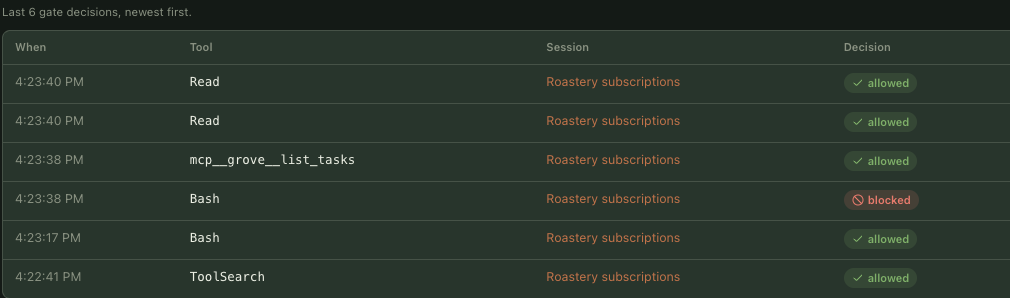
The log shows five allowed calls and one blocked Bash call.
Task lists
We built six reusable task lists, one for each kind of work.
Each session started with the right list attached, so the agent knew what it had to show before a task could close.
A proof is evidence the agent attaches to a task, such as a screenshot or command output.
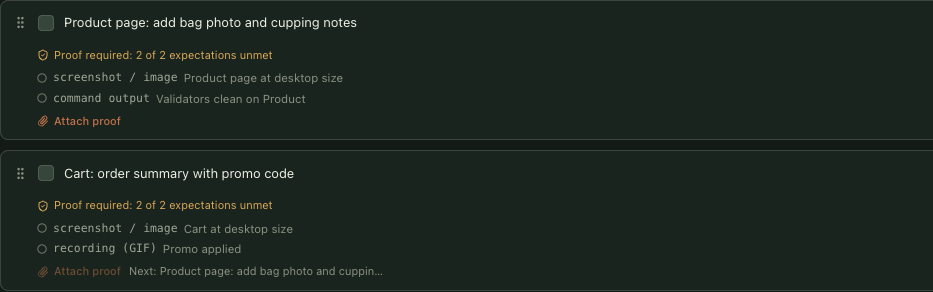
Each task lists the proofs it still needs.
The loop
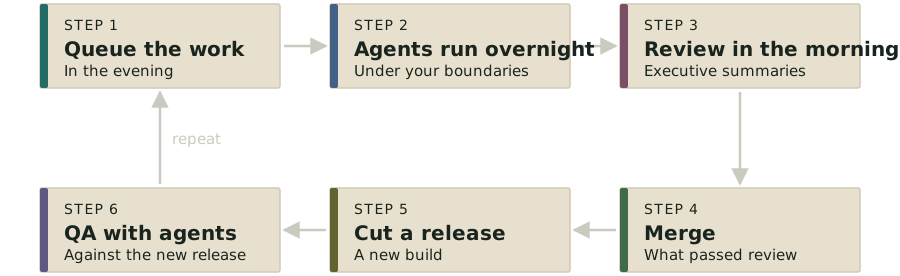
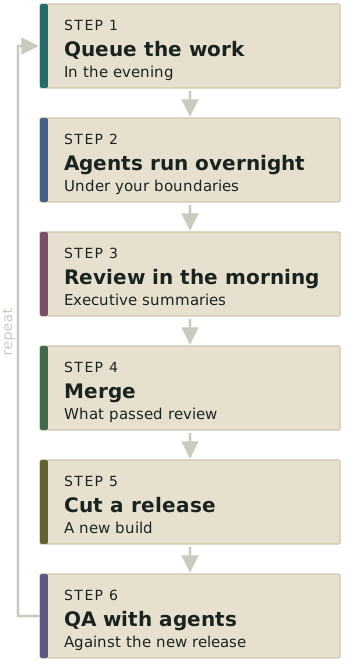
The daily loop, six steps
The only step that needed a person was the morning review. Each task came back with its evidence attached, and when something needed cleaning up, we left feedback directly on the running app in the preview browser.
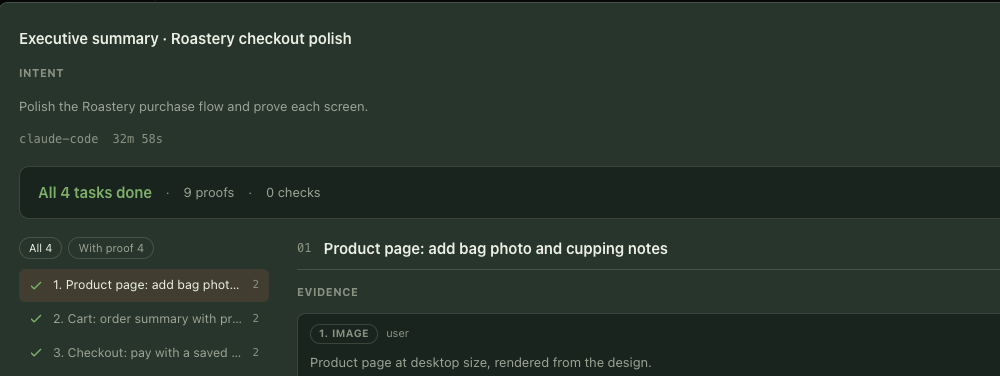
The summary counts 4 finished tasks and 9 proofs.
Results
From June to November 2026, agents closed about 1,700 tasks a month, and about 95% passed review the first time.
Tasks closed
1,700 a month
Across 215 sessions a month
Releases tagged
54 a month
Largest overnight queue
30 sessions
Review time each morning
30 minutes to a couple of hours
Sessions and review
Sessions run overnight
90%
Passed review the first time
95%
Share of tasks closed, by kind of work
Features
66%
Bug fixes
23%
Chores
11%
A task counts as closed once the agent attaches the required evidence and the checks pass. It counts as passing review when it merges without going back to the agent.
Every task list made the agent run the project's tests before a task could close.